


Homily for the 19th Sunday after Pentecost – Sermon
“Love your enemies, and you will be sons of the Most High” (Luke 6:35)
Gospel Reading (Luke 6:31–36)
“And as you wish that others would do to you, do so to them. If you love those who love you, what credit is that to you? For even sinners love those who love them. And if you do good to those who do good to you, what credit is that to you? For even sinners do the same. And if you lend to those from whom you expect to receive, what credit is that to you? Even sinners lend to sinners, to get back the same amount. But love your enemies, and do good, and lend, expecting nothing in return; and your reward will be great, and you will be sons of the Most High, for He is kind to the ungrateful and the evil. Be merciful, even as your Father is merciful.”
-
The Word that Turns the World Upside Down
These words of Christ are among the deepest in the Gospel, for they contradict human logic. We naturally seek justice, yet Christ calls us higher—to a love that overcomes evil with good. He does not abolish justice but reveals its true depth: justice that heals rather than avenges. Saint Paul writes, “Do not be overcome by evil, but overcome evil with good” (Romans 12:21). This is not a call to weakness but to spiritual victory—to the power of love that transforms rather than destroys.
Mercy Is Not Weakness but the Power of God
Mercy is not mere pity; it is the reflection of God’s nature within us. Saint Isaac the Syrian said, “Mercy is a heart burning with love for all creation, even for those who do evil.” God never ceases to love even the sinner; He hates sin but sees in every person His image. Therefore, love for one’s enemy is not approval of evil but a desire for the salvation of every soul. Saint Silouan the Athonite taught, “When you pray for your enemies, the Holy Spirit dwells in you; when you hate, you extinguish grace within yourself.”
Love of Enemies in Time of War
Today, as Ukraine suffers through a brutal war, these words sound almost unbearable. We see pain, death, and destruction—and anger naturally arises in the heart. Yet Christ does not ask us to feel affection toward evil; He calls us to be free from hatred. For if hatred rules our hearts, evil wins within us even if we defeat it outwardly. Love of enemies in time of war is a form of spiritual courage: to stand against evil without becoming its reflection. To pray that God may stop the aggressor and enlighten the hearts blinded by hatred.
A Story of a Soldier and Mercy
During the war, a young soldier was captured and sentenced to death. When asked for his last words, he said, “I pray that God will forgive both me and you, for I do not wish to die with hatred.” The executioner lowered his weapon—unable to kill one who forgave. Years later, that executioner converted to Christ. This story reveals that mercy can melt even the hardest heart, for where love acts, even an enemy may rise to life.
Mercy as the Resurrection of the Heart
Mercy is participation in God’s grace. When we forgive, we do not justify sin—we free our hearts for God’s action. Christ says, “Be merciful, even as your Father is merciful” (Luke 6:36).
This is not advice but a commandment, for only the merciful heart sees God. Saint Isaac the Syrian adds, “If you see your brother fall into sin and do not weep for him, you have not yet known God’s love.” Mercy is the resurrection of humanity itself—a resurrection our world desperately needs.
Conclusion
Brothers and sisters, we may defeat the enemy on the battlefield, but the true victory is to keep the heart alive. Love of the enemy is not agreement with his evil—it is faithfulness to Christ even in the hell of war. It means remaining human where others have forgotten what humanity is. May the words of our Savior, “Love your enemies, and you will be sons of the Most High” (Luke 6:35), become the prayer of our nation, that the love of God—through the Cross—may raise Ukraine to peace and life. Amen.
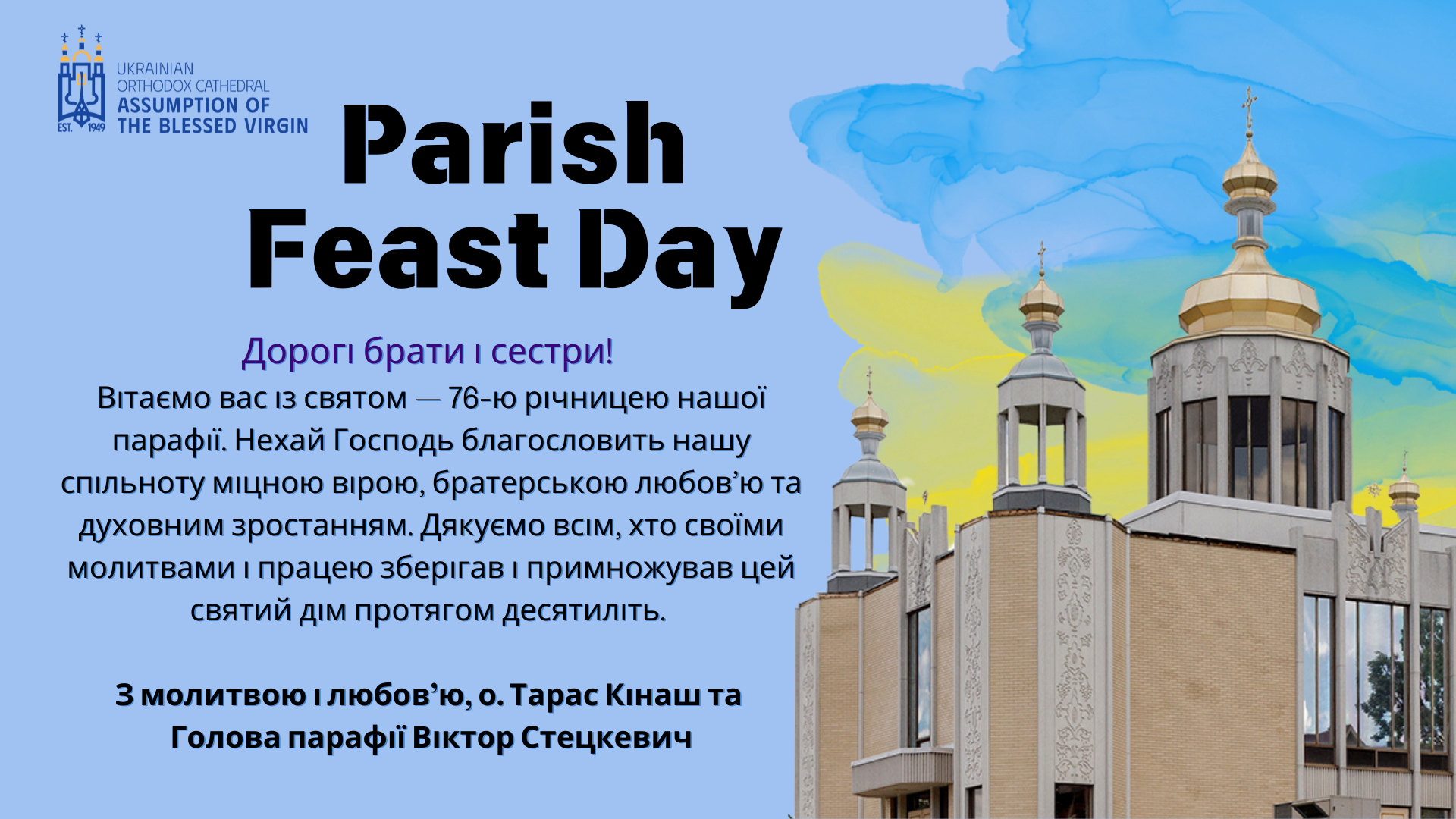
Parish Feast Day - Sermon
Beloved brothers and sisters in Christ,
Today, we hear of the Canaanite woman, a foreigner whose faith surpassed many of the chosen. Christ’s silence was not rejection but testing. Her prayer was the cry of a mother who trusts even when Heaven seems silent. This is the faith of the Church — a faith that never gives up, a faith that perseveres in love.
St. Cyprian of Carthage wrote: “He cannot have God as his Father who does not have the Church as his Mother.” Through the Church we come to God, through her prayers we receive grace, through her Sacraments we are born into eternal life.
Sunday, 5 October, 2025
-
The Church is not a building — it is the living heart of Christ on earth. When we are united in prayer and love, Christ Himself dwells among us.
Parish life is not only about prayer, but also about sacrificial love, where everyone offers something of themselves. St. Paul says: “God loves a cheerful giver” (2 Cor. 9:7). The Church lives through the love of her children. Every candle, every offering, every moment of service is a prayer rising to Heaven.
St. John Chrysostom reminds us: “Nothing is stronger than the Church; not even the gates of hell shall prevail against it.” When we stand together in prayer, we are unshakable. When we share love, we overcome darkness. Our parish is a family in Christ — a place where God works through human hearts.
Today, we thank the Lord for 76 blessed years of our parish — a home built by the prayers and faith of generations. We express heartfelt gratitude to all of you for your love, service, and generosity, especially to those who contributed to the fundraising and restoration of our church. May the Lord richly reward every faithful heart that sustains this holy house, our spiritual Mother, in whose embrace we grow toward salvation.
May the Lord strengthen our community so that, in faith, love, and generosity, we may always remain the children of our Holy Mother — the Church. Amen.
Rev. Fr. Taras Kinash

The Nativity of the Most Holy Theotokos - Sermon
In the name of the Father and the Son and the Holy Spirit. Amen
Glory to Jesus Christ!
Dear brothers and sisters,
Every event that took place in the history of salvation or described in the Gospel carries a deep spiritual meaning for us even today. The Holy Orthodox Church solemnly celebrates the Nativity of the Most Holy Theotokos - the day when her earthly life began. This holiday reminds us that God always hears prayers, appreciates our efforts and generously rewards those who believe and persistently seek His support.
Sunday, 15 September, 2024
-
The story of a woman who sincerely prayed to the Holy Mother of God for the safe return of her husband from the war vividly demonstrates the power of faith and the importance of endurance in times of trials. When she heard the terrible news of the death of her husband, despair and anger seized her heart, which led to a temporary loss of faith. However, The Mother of God does not leave her children. With time had passed, the woman was informed that the husband was alive, albeit wounded. This became a moment of her deep remorse and boundless gratitude for the maternal care of the Queen of Heaven. Since then, she had shared her story with the world, emphasizing that God's love is constant and He tirelessly cares about us all.
The earthly life of the Mother of God is a way of spiritual nobility and dignity for every person. Celebrating Her birth is our opportunity to express our gratitude for Her participation in our lives, for Her constant presence and help.
The Nativity of the Blessed Virgin Mary is an important reminder of the power of faith, prayer and God's mercy. This day testifies that even in the darkest moment of life, one should not lose hope. The Mother of God is always ready to support Her earthly children and lead them to the light. Her life example of spiritual stability inspires us on a righteous, worthy path, filled with faith, gratitude and humility before God's grace.
Rev. Fr. Taras Kinash